The Big Bad Wolf 🐺
Then I'll huff and I'll puff and I'll blow your house down.
- The Big Bad Wolf
When you hear talk of the PCT, it's often said that it's "graded for pack animals". Meaning nothing is too steep and generally you could expect to do it on horseback. It also means you shouldn't expect too many obstacles that require you to scramble with hands and feet. The stretch from Paradise Valley Cafe (PVC, another much talked about PCT checkpoint) to saddle junction down to Idyllwild was easily the toughest stretch of trail so far, and the only one that has made me question the claim of it being doable by pack animals so far.
I went into this stretch with no expectations, just that there would be a good amount of climbing to be done. So, I wanted to make sure I was nice and fueled up on what some call "the best burger on the trail". I woke up and did about six and a half miles to the road leading to PVC. I attempted my first hitch, I was thankful to be with Too Clean – he is a hiker I met the day before and is a triple crowner, so he has plenty of hitching experience — after about 10 minutes of trying for a hitch a car going the other direction pulled over and u-turned. Turns out a trail angel named "Grumpy" regularly serves this section of trail and is always on the lookout for hikers hitching to and from PVC. I got seated and was early enough to order some breakfast. I ordered an egg platter and ate the whole thing. A couple hours later the lunch menu was available. We got lucky, it was the last day the full menu was available, PVC is so popular with hikers that they switch to a special reduced menu for PCT season to make it easier on the kitchen. I got a Gus burger, the Texas toast bun appealed to me.
After saying hi to some hiking friends who arrived later and planned on staying a while, my friend Keleo and I started to head back to trail. Grumpy had left to help shuttle hikers further down the trail to Idyllwild, so we planned to walk the mile back to trail. We held our thumbs up to hitch when cars passed us, and we had luck! Not too far into our walk, someone pulled over and offered us a ride up the road. He was familiar with the PCT and keen to ask a few dirty hikers some questions. First real hitch completed!
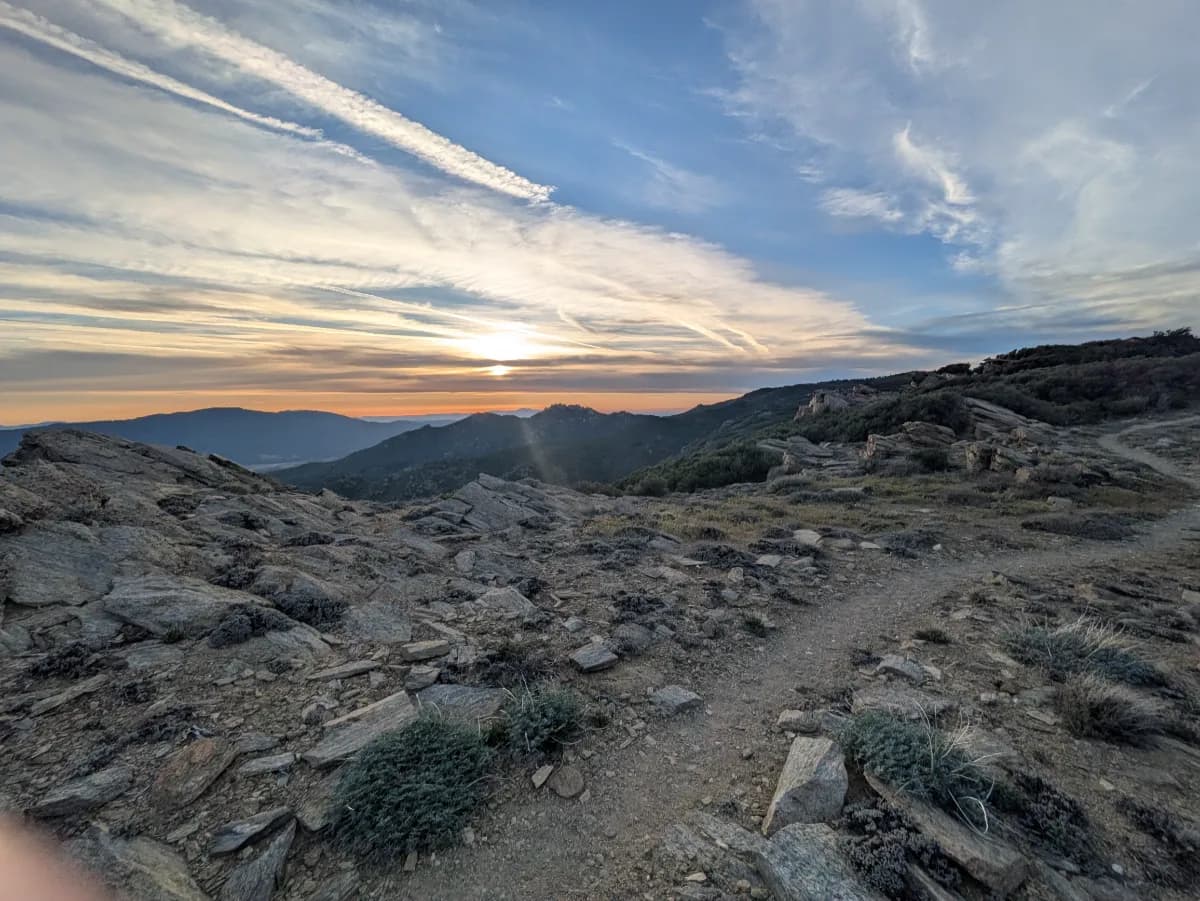
Here is where the trials began... To be fair, the first few miles were not too bad. Some elevation gain, but nothing crazy. After a couple of hours I got sluggish, who would have thought going out to walk in the sun after two large meals would play out that way? Despite this, I continued on. Eventually the scrubby brush of the desert floor started to turn to pine trees and granite terrain. At the beginning of Golden hour, I started to walk a ridge and felt serene. It was the first time the trail felt truly mountainous, a breeze was brewing and the pine needles in the trees glowed with the setting sun's light. At this point the trail had become a bit more rocky and uneven, but remained within the realm of what I expected from the PCT.
I made it to camp at a reasonable hour and noticed the breeze had picked up quite a bit and there were now very strong sustained winds with powerful gusts interspersed. The available tent sites didn't have great wind protection so I chose the flatter one and dropped my pack there. I didn't set up camp for the night yet, because I still had two more miles to hike and I wanted to do it before it was dark. This stretch of trail has a large span where there is no on trail water. To fill up, you have to do a steep hike down to springs that are further down the mountain. These trails are anywhere from half a mile to a mile long. The spring I was camping above, Cedar Spring, had a long trail but was considered one of the flatter options... The path down to cedar spring was not flat. Going down the mile was quick because of how steep the decline was. The area around the spring felt like a paradise. As the name implies, Cedar Spring is surrounded by a grove of beautiful cedar trees. It was also far enough down the ridge to offer a respite from the wind. When filling my bottles I saw multiple people who chose to camp down there, out of the wind. Once I had filled up, I made the trek back up the hill. It was steep and climbing was slower than coming down, but thanks to not having my pack I still got back up to camp relatively quickly.
What do you call a trekking pole tent? Would it be considered a house of sticks? Maybe a house of cloth? Either way, setting up my tent in the now very powerful winds was not the most fun activity ever. Now that I had hiked my final two miles, it was dark and the winds were at their peak. As I started to take my tent out, I had to pin it down so it wouldn't blow away; as I held it in place the stuff sack it came out of took a ride on a gust. This was the point at which the weight of an off-handed comment one of the hikers now camping down at the spring made hit me. 'I guess wind is part of being in this mountain range'. I didn't know ahead of time, but apparently this is a very windy area which would become apparent the next day. But, for the present, it made setting up my tent a game of placing rocks on top of everything that could move and staking my tent down as securely as I could muster. I even made sure to place rocks on all of my tent stakes to make sure they stayed in place. All of this was made more difficult by the fact that I am still new to my trekking pole tent and am not the best at pitching it yet. It took more than twice as long as normal but I did finally manage to pitch my tent. Around that time Keleo, who camped nearby, finished setting up and came to see if I needed help. I told him I had it under control now that my tent was up and could block some of the wind for me.
I put my things in my tent and started the rest of my setup. I pulled out my sleeping pad and tried to attach the inflation sack, but it would just not snap into place. I'd never had this issue before, and was annoyed it happened after I already struggled through getting my tent standing. After I had spent around five minutes trying to get the socket to snap in place, I realized that my water bladder was slowly leaking. I stopped inflating my sleeping pad to filter my water into bottles so that I wouldn't have to deal with the bladder leaking. As I was half way through my first bottle, one of my tent poles fell over, causing half the tent to collapse. I turned my focus to deal with my collapsing tent, meaning my filter might start dripping water again. The next 45 minutes was a struggle of going between managing my tent poles, tent stakes and trying to get my sleeping pad to fill.
Eventually everything seemed stable. Tent stakes were holding well, sleeping pad was inflated, sleeping bag was out. Then my tent/trekking pole started to collapse again. I fought for a while to keep them up, but was bested. I worried that even if my poles held, which seems unlikely, they might end up breaking. So I decided to let the big bad wolf blow my house down. I didn't have the energy — and wasn't sure it would help — to find another tent site. Instead, I laid my poles down and slept on my collapsed tent. I could have cowboy camped (slept outside of my tent) since I was too high for snakes to be an issue, but I actually liked having my collapsed tent around me, it helped break the wind and kept my things from blowing away. I did not sleep well. I do think this comes down to user error, I have heard good things about my tents abilities to manage a storm.
In the morning I had planned to make a 14 mile push to the next water source where I would take my first break. This would leave me a short ways from the 2.5 mile Devil's Slide trail that leads to Idyllwild. However, I learned what the San Jacinto mountains are about. The wind was not a night phenomenon, this is a land where the trees grow sideways and the birds get stuck in the wind. I was blown around by strong bursts of air all day, sometimes having to fight to not get pushed into a rock or bush or even to make sure I didn't fall off a ledge. The terrain was brutal, it was rocky in a way that required much more effort to move and navigate. There were times that required minor scrambling and resulted in tons of blown down trees on the trail, adding additional obstacles to navigate. There were parts of the trail that were slightly washed out. I kept thinking that this area is still supposed to be covered in snow this time of year, I can only imagine how challenging and dangerous that would be. I guess the heat wave has its upsides.
Due to the terrain, I only managed 9 miles before I had to take a break and eat. I needed the calories to continue my march upwards, and it was already past 11; it was slow moving. Despite the difficulties with the trail quality, I was constantly struck by how beautiful these mountains were. Granite faces and patches of snow were everywhere, first snow I've seen on the PCT! As I was getting ready to stop I saw Keleo, who left camp before me, sitting at a camp site enjoying his lunch. I joined him for a bit before he set off. After lunch I was much refreshed and the worst of the climbing was over, I made the final 5 miles to the creek without too much issue. I was a bit lethargic due to my bad sleep the night prior, but a mile or so before the creek the trail became super well maintained. Similar to Mount Laguna, entering a pine forest with well maintained paths helped carry me to the finish line. The similarities are not fully a coincidence, see below for why this sudden switch happens multiple times.
Once I made it to the stream, I took a brief pause and then pushed on. I wanted to make it to town before it was too late. Now that I am here, I have a rare double zero — two days of no hiking — to look forward to.
Day Use Areas
As I suggested above, it is actually common for the last stretch of trail before making it to town to be very well maintained. That's because there are a lot of day and weekend hikers that visit these paths from the mountain towns, meaning the trails in those areas have a lot more work put into keeping them maintained.
The land designation also often changes near the towns. Some parks have different rules on what is allowed in that area. For example, wilderness areas don't allow chain saws, so creating a path through blow downs doesn't usually happen. Whereas the area directly surrounding Idyllwild transitions to a state park, which is more permissive and caters towards day use and more recreational forms of hiking.